
eSIM Technology Is Moving Fast
The future of eSIM technology looks nothing like where we started. When the first embedded SIMs shipped in smartwatches back in 2016, most people dismissed them as a niche feature. Fast forward to 2026, and eSIMs are standard equipment on flagships from Apple, Samsung, and Google. But the real changes? They’re coming in 2027.
According to GSMA’s latest intelligence reports, eSIM connections are expected to surpass 5 billion globally by the end of 2027. That’s not just phones. We’re talking cars, laptops, wearables, industrial sensors, and devices that don’t even exist yet. The shift from physical SIM cards to embedded and integrated solutions is accelerating, and 2027 will be a tipping point for several reasons.
This article breaks down the specific technologies, industry moves, and consumer changes you should watch for over the next 12 to 18 months.
iSIM: The Chip That Replaces the Chip
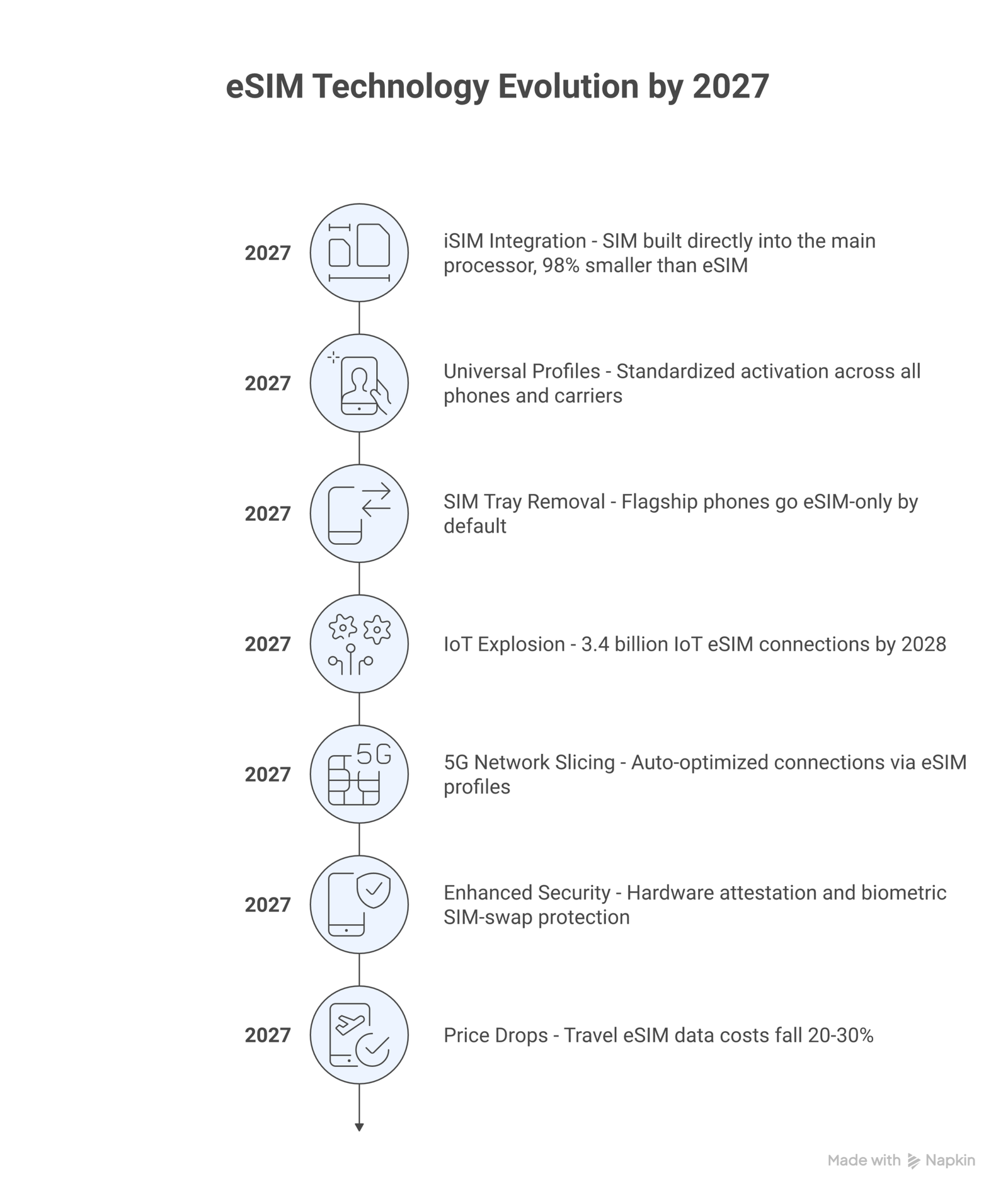
The biggest technical leap coming in 2027 is iSIM, or integrated SIM. Where an eSIM is a separate chip soldered onto the motherboard, iSIM bakes the SIM functionality directly into the device’s main processor. Arm Holdings has been developing the iSIM specification alongside Qualcomm, and commercial devices running iSIM are expected to hit the market in 2027.
Why does this matter? Three practical reasons. First, it frees up physical space inside devices, which matters when you’re trying to fit bigger batteries into smaller phones. Second, it reduces manufacturing costs since there’s one fewer component to source and solder. Third, it opens the door for much smaller connected devices. Think smart rings, medical implants, or industrial sensors the size of a coin.
Qualcomm achieved GSMA iSIM certification in early 2023, making it the first chipmaker to do so. Since then, the ecosystem has been building out. By 2027, expect iSIM to appear in mid-range Android phones and IoT modules, not just flagship devices.
✓ iSIM advantages over eSIM
- ✓ 98% smaller footprint than traditional eSIM chips
- ✓ Lower power consumption for battery-constrained devices
- ✓ Reduced bill of materials for manufacturers
- ✓ Same security standards as standalone eSIM (GSMA certified)
- ✓ Enables connectivity in devices too small for eSIM chips
Universal eSIM Profiles Are Coming
One of the biggest frustrations with eSIM today is the fragmented activation process. You buy an eSIM from Airalo, and the setup looks completely different than buying one from your local carrier. Apple has one flow, Samsung has another, and Google Pixel does its own thing. This is about to change.
The GSMA’s Consumer eSIM specification (SGP.22 v3.1) introduces a standardized remote provisioning architecture. In plain terms: downloading and activating an eSIM plan should work the same way regardless of your phone brand or carrier. The spec was finalized in late 2025, and carrier adoption is rolling out through 2026 and 2027.
For travelers, this means less confusion. Instead of scanning QR codes and manually entering activation details, you’ll tap a button in your phone’s settings, browse available plans for your destination, and activate one in seconds. Apple is already heading this direction with its eSIM marketplace built into iOS, and Android is expected to match this by mid-2027 with a native eSIM store in the settings app.
The Physical SIM Slot Is Disappearing
Apple removed the SIM tray from all US iPhone models starting with the iPhone 14 in 2022. At the time, it felt aggressive. By 2027, it’ll look like an early move. Samsung is expected to follow with eSIM-only Galaxy S models in select markets by late 2027, according to reporting by SamMobile. Google’s Pixel line is also trending eSIM-first, with the Pixel 9a already shipping eSIM-only in multiple regions.
This doesn’t mean physical SIMs vanish overnight. In regions where carrier infrastructure hasn’t caught up, like parts of Africa and South Asia, nano-SIM slots will persist through at least 2029. But for travelers deciding between eSIM and physical SIM, the writing is on the wall. If you haven’t tried eSIM yet, 2027 might not give you a choice.
The list of eSIM-compatible phones in 2026 already covers nearly every device over $300. By 2027, that threshold drops to budget phones in the $150 range.
💡 Pro Tip
If you’re buying a phone in 2026 or 2027, make sure it supports eSIM. Even if you’re using a physical SIM now, having eSIM capability gives you a backup option for travel and lets you run dual plans without a second SIM slot.
IoT and eSIM: Billions of New Connections
Consumer phones get the headlines, but the real volume story for eSIM in 2027 is the Internet of Things. Juniper Research projects that IoT eSIM connections will reach 3.4 billion by 2028, up from around 800 million in 2025. That growth is driven by connected cars, smart meters, asset trackers, and industrial equipment that needs cellular connectivity without anyone physically inserting a SIM card.
For the automotive sector, eSIM is becoming mandatory. The European Telecommunications Standards Institute (ETSI) requires all new cars sold in the EU to have eCall capability, which depends on embedded cellular connectivity. BMW, Mercedes, and Tesla already use eSIMs for over-the-air updates, navigation, and emergency services. By 2027, most new vehicles globally will ship with eSIM as standard.
This IoT expansion also affects consumers indirectly. As carriers invest in eSIM infrastructure to support billions of IoT devices, that same infrastructure makes consumer eSIM activation smoother and more reliable. Wearables like smartwatches are already benefiting from this, with standalone cellular plans becoming simpler to manage.
5G Standalone and eSIM Work Together
The rollout of 5G Standalone (SA) networks is happening in parallel with eSIM adoption, and the two technologies reinforce each other. 5G SA enables network slicing, where a single physical network can be divided into virtual networks optimized for different use cases. Your eSIM profile could automatically connect to a low-latency slice for video calls or a high-bandwidth slice for streaming, depending on what you’re doing.
Ericsson’s 2026 Mobility Report estimates that 5G SA coverage will reach 60% of the global population by the end of 2027. Combined with eSIM’s ability to switch profiles remotely, this creates a scenario where your phone can pick the best available network and configuration without you doing anything.
For digital nomads and frequent travelers, this combination is powerful. Imagine landing in a new country, and your phone automatically activates a local eSIM plan on the fastest available 5G slice. That’s the direction we’re heading.
eSIM Security Gets an Upgrade
Security has always been an advantage of eSIM over physical SIM cards. You can’t pop out an eSIM and clone it, and remote provisioning uses encrypted channels. But 2027 brings improvements that matter.
The GlobalPlatform consortium is finalizing updated secure element specifications that strengthen how eSIM credentials are stored and transmitted. This addresses a growing concern: as eSIM becomes ubiquitous, it becomes a bigger target. The new specs add hardware-level attestation, meaning the device can cryptographically prove its identity to the carrier before a profile is downloaded.
SIM-swapping attacks, which bypass eSIM security through social engineering at the carrier level, are also being addressed. Several major carriers are rolling out biometric verification requirements for eSIM profile transfers, making it much harder for attackers to hijack your number. The FCC’s 2024 rules on SIM-swap protection are pushing carriers in the US to tighten these controls, with full compliance expected by mid-2027.
📝 Important Note
Even with improved security, you should enable two-factor authentication on your carrier account and avoid using SMS-based 2FA for critical accounts like banking. Use an authenticator app instead.
What This Means for Travelers in 2027
If you travel internationally, the eSIM experience in 2027 will feel meaningfully different from today. Here’s what to expect:
Easier activation. Standardized provisioning means less fiddling with QR codes and manual APN settings. You’ll browse plans, tap to activate, and be connected. The activation process that currently takes 5 to 10 minutes should drop to under 60 seconds.
More competitive pricing. As eSIM infrastructure costs drop and more MVNOs enter the market, expect data prices for travel eSIMs to fall 20 to 30% from current levels. Competition from providers like Airalo, Holafly, and Nomad is already driving prices down, and new entrants in 2027 will accelerate this.
Better coverage. More carriers worldwide are supporting eSIM activation. Countries that were eSIM dead zones in 2024, like parts of Central Asia and West Africa, are rapidly adding support. By 2027, eSIM coverage will be viable in over 200 countries and territories.
Multi-device simplicity. Managing eSIM plans across your phone, tablet, and laptop will get easier with cloud-based profile management. Change your plan on one device, and it syncs across all your connected devices automatically.
Carrier Resistance Is Fading
Carriers dragged their feet on eSIM for years. The reason was simple: physical SIM cards create switching friction. If changing carriers means going to a store and swapping a card, many people won’t bother. eSIM removes that friction entirely. You can switch carriers from your couch in minutes.
But the tide has turned. T-Mobile, Vodafone, and other major carriers now actively promote eSIM as a feature. The economics make sense: eSIM activation costs carriers less than mailing physical SIM cards, staffing stores for activations, and dealing with lost or damaged SIMs. A 2025 analysis by Counterpoint Research found that carriers save an average of $3.50 per activation by moving to eSIM.
Regulatory pressure is helping too. The EU’s Digital Markets Act and similar legislation in other regions require carriers to support number portability and eSIM activation without unnecessary barriers. By 2027, refusing to support eSIM won’t just be a competitive disadvantage; in some markets, it’ll violate regulations.
What Won’t Change (Yet)
Not everything improves overnight. A few things will still be pain points in 2027:
Phone number portability across countries remains complicated. If you move from Germany to the US, you still can’t easily keep your German number active on an eSIM while using a US plan as your primary line. This is a regulatory problem more than a technical one, and it won’t be solved by 2027.
Budget phones in developing markets will still use physical SIMs. While flagship and mid-range devices go eSIM-only, the $50 to $100 phone segment will maintain SIM trays. These markets often have limited carrier eSIM support anyway.
Enterprise eSIM management is still maturing. Managing hundreds of eSIM profiles across a corporate fleet is harder than bulk-buying physical SIMs. MDM (Mobile Device Management) platforms are catching up, but enterprise-grade eSIM orchestration won’t feel seamless until 2028 or so.
⚠️ Disclaimer
Technology predictions are based on current industry trends, published roadmaps, and analyst reports as of March 2026. Actual timelines may shift depending on carrier adoption, regulatory changes, and manufacturer decisions.
Frequently Asked Questions
Will physical SIM cards be completely gone by 2027?
No. Physical SIM cards will still be available in most markets through 2027 and beyond. However, flagship phones from Apple, Samsung, and Google are trending eSIM-only. Budget phones in developing markets will retain SIM trays the longest.
What is iSIM and how is it different from eSIM?
iSIM (integrated SIM) builds the SIM functionality directly into the phone’s main processor, while eSIM is a separate chip on the motherboard. iSIM is smaller, cheaper, and uses less power. Both provide the same remote provisioning features for downloading carrier profiles.
Will eSIM plans get cheaper in 2027?
Yes, travel eSIM data plans are expected to drop 20 to 30% as more providers enter the market and carrier infrastructure costs decrease. Competition among MVNO providers like Airalo, Holafly, and newer entrants will push prices down.
Is eSIM more secure than a physical SIM card?
Generally yes. eSIMs can’t be physically removed or cloned, and profile downloads use encrypted channels. However, SIM-swapping attacks at the carrier level are still a risk. New security specifications coming in 2027 add hardware attestation and biometric verification to address this.
How will 5G affect eSIM technology?
5G Standalone networks enable network slicing, which works naturally with eSIM. Your eSIM profile can automatically connect to optimized network slices for different activities like streaming, gaming, or video calls. By 2027, 5G SA is expected to reach 60% of the global population.