
You just landed at Rome Fiumicino, your phone has no signal, and the airport SIM kiosk has a 45-minute queue. Sound familiar? An eSIM for Italy solves this problem before you even board your flight. You activate it from your couch, land with data ready, and skip the hassle entirely.
Italy gets over 50 million international tourists annually, according to ISTAT (Italy’s National Statistics Institute). Whether you’re navigating the narrow streets of Florence, booking a last-minute Vesuvius tour, or translating a menu in a tiny Sicilian trattoria, reliable mobile data is non-negotiable. This guide covers everything you need to know about using an eSIM in Italy, from providers and pricing to activation and coverage. If you’re new to the technology, our beginner’s guide to eSIM explains the basics.
What is an eSIM and why use one in Italy?
An eSIM (embedded SIM) is a digital SIM card built into your phone. Instead of swapping a tiny plastic card, you scan a QR code or download a profile, and your phone connects to a local network. The GSMA, the global trade body for mobile operators, has been pushing eSIM adoption since 2016, and most modern phones now support it.
For Italy specifically, an eSIM makes sense for a few practical reasons. Italian mobile data is cheap compared to international roaming charges. You can set up your plan before leaving home. And if you’re using a dual-SIM phone, you keep your home number active for calls while using Italian data for everything else.
✓ Why travelers choose eSIM for Italy
- ✓ Activate before you fly, land with data working immediately
- ✓ Avoid airport SIM queues and overpriced tourist SIM cards
- ✓ Keep your home number active on a dual-SIM device
- ✓ Switch providers instantly if coverage is weak in rural areas
- ✓ No risk of losing a tiny physical SIM card during your trip
Which phones support eSIM in Italy?
Before buying an eSIM plan, check that your device actually supports it. Carrier-locked phones sometimes have eSIM disabled even if the hardware supports it, so verify with your carrier if you’re unsure.
Apple devices: iPhone XS and newer (including all iPhone 15 and 16 models), iPad Pro (3rd gen+), iPad Air (3rd gen+), and Apple Watch Series 3+. The iPhone 14 US models and all iPhone 15/16 models are eSIM-only with no physical SIM tray at all.
Android devices: Google Pixel 3 and newer, Samsung Galaxy S20 and newer, Samsung Galaxy Z Flip/Fold series, Motorola Razr 2022+, OnePlus 12, and Xiaomi 14. The Android phones directory has the full list filtered by eSIM support.
A quick way to check: on iPhone, go to Settings > General > About and look for “Digital SIM” or “eSIM”. On Android, go to Settings > Network & Internet > SIMs and check if “Add eSIM” appears.
Best eSIM providers for Italy in 2026
The eSIM market for travelers has gotten competitive, which is good news for pricing. Here are the providers worth considering for an Italy trip, based on coverage, data allowances, and actual user experience.
Airalo is probably the most well-known eSIM provider for travelers. Their Italy plans start around $4.50 for 1 GB (7 days) and go up to $16 for 10 GB (30 days). They use WindTre and Vodafone Italy networks, so coverage is solid across the country. The app is clean, activation takes about two minutes, and they have 24/7 chat support.
Holafly stands out because they offer unlimited data plans for Italy. Prices start at around $19 for 5 days and $47 for 15 days. If you’re someone who streams music all day, video-calls family back home, or just doesn’t want to think about data limits, Holafly is the obvious choice. They connect through local Italian networks including TIM.
Nomad offers competitive pricing with plans starting at $5 for 1 GB. Their Europe-wide plans are particularly useful if you’re combining Italy with other countries. A 10 GB Europe plan runs about $25 for 30 days and works across 30+ European countries.
Ubigi has a direct partnership with GSMA and offers both Italy-specific and European plans. Their 3 GB Italy plan costs about $9 for 30 days. Ubigi is pre-installed on some Windows laptops and tablets, which is handy if you’re traveling with multiple devices.
aloSIM is the budget pick. Their Italy plans start as low as $3.50 for 1 GB. The app interface isn’t as polished as Airalo, but the data works fine and the savings add up on longer trips.
💡 Quick comparison tip
If you’re visiting only Italy for under a week, go with a country-specific plan from Airalo or aloSIM. If your trip includes multiple European countries, grab a regional Europe plan from Nomad or Airalo instead. You’ll pay a bit more per GB but avoid buying separate eSIMs for each country.
How to set up your eSIM for Italy
Setting up an eSIM takes less than five minutes. The process is almost identical across providers, though the exact menu names vary slightly between iPhone and Android.
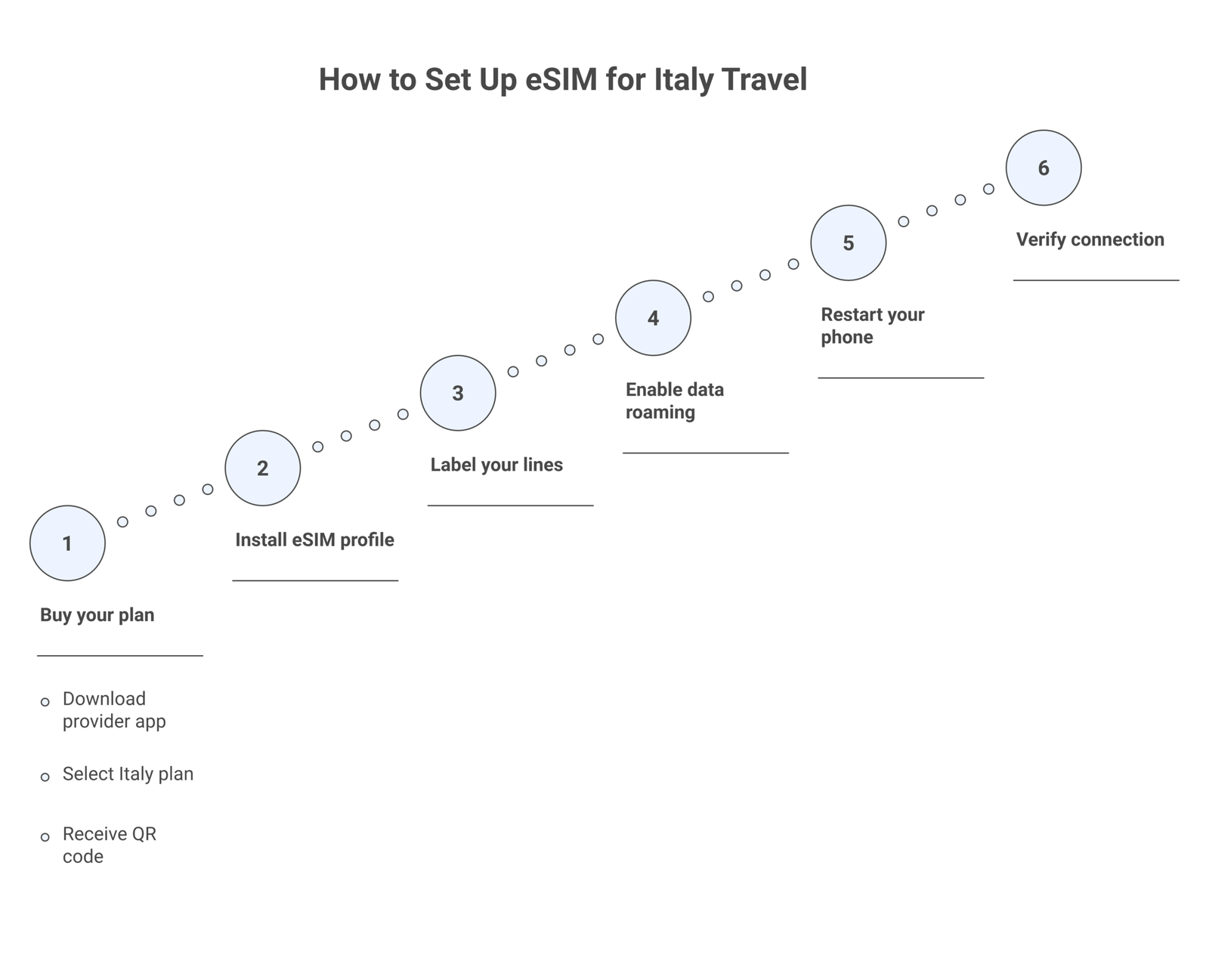
Step 1: Buy your plan. Download your provider’s app (Airalo, Holafly, etc.) or visit their website. Select an Italy or Europe plan, pay, and you’ll receive a QR code, either in the app or via email.
Step 2: Install the eSIM profile. On iPhone, go to Settings > Cellular > Add eSIM > Use QR Code and scan it (see our full iPhone eSIM activation guide). On Android, go to Settings > Network & Internet > SIMs > Add SIM and scan the QR code. You need a Wi-Fi connection for this step since you’re downloading the carrier profile.
Step 3: Label your lines. Your phone will ask you to label the new line. Something like “Italy Travel” works. Set your primary line for calls/texts and the eSIM for mobile data.
Step 4: Activate when ready. Some eSIMs activate immediately upon installation, others activate when you first connect to a local network. Check your provider’s instructions. Most recommend installing the eSIM at home but waiting to enable data until you land in Italy.
Step 5: Enable data roaming. This catches a lot of people. Even though you’re using a local Italian eSIM, your phone may classify it as “roaming” since it’s not your primary carrier. Go to your eSIM line settings and toggle on Data Roaming. Without this, you’ll have signal bars but no internet, according to Apple’s support documentation.
📝 Do this before you leave home
Install your eSIM while you still have Wi-Fi at home. The QR code can only be scanned once, so if something goes wrong during installation, you want to troubleshoot with a stable internet connection rather than scrambling at the airport.
Italy mobile network coverage: what to expect
Italy has four main mobile networks: TIM, Vodafone, WindTre, and Iliad. TIM and Vodafone have the best overall coverage, especially in rural areas and along highways. WindTre merged in 2020 and has strong urban coverage but can be patchy in mountainous regions.
In major cities like Rome, Milan, Florence, Naples, and Venice, you’ll get solid 4G LTE everywhere. Most urban areas also have 5G coverage through TIM and Vodafone, though 5G eSIM plans for tourists are still limited. According to AGCOM (Italy’s communications regulator), 4G coverage reaches over 99% of the Italian population.
Where things get tricky: the Dolomites, parts of Sardinia’s interior, small Sicilian hill towns, and some stretches of the Amalfi Coast have weak spots. You’ll usually still get basic connectivity, but speeds might drop. If you’re hiking in the Alps or exploring remote Sardinian beaches, don’t rely on mobile data for navigation. Download offline maps through Google Maps offline before heading out.
Train connectivity is decent on high-speed routes (Frecciarossa, Frecciargento) between major cities, but expect dropouts in tunnels, especially on the Rome-Naples line which passes through several long tunnels. Trenitalia offers onboard Wi-Fi on high-speed trains, but it’s unreliable. Your eSIM data will usually be faster.
How much data do you actually need in Italy?
This depends on how you use your phone while traveling. Here’s a realistic breakdown based on common traveler activities:
Light user (1-2 GB per week): You use Google Maps for directions, send WhatsApp messages, check email, and browse occasionally. You connect to hotel/cafe Wi-Fi for heavier tasks. A 1-3 GB plan will last your trip.
Moderate user (3-5 GB per week): You post photos to Instagram daily, use Google Translate frequently, make some video calls, and stream a bit of music. A 5-10 GB plan is the safe choice.
Heavy user (5+ GB per week): You stream Netflix at the hotel, do video calls regularly, share lots of photos and videos, and basically live on your phone. Go unlimited with Holafly or grab a 10+ GB plan.
One thing worth noting: Google Maps uses surprisingly little data. According to Google’s documentation, typical navigation uses about 5-10 MB per hour. So even on a 1 GB plan, maps alone won’t burn through your allowance.
eSIM vs physical SIM card in Italy: which is better?
You can still buy physical SIM cards at Italian airports and TIM/Vodafone stores in most cities. We’ve covered the full eSIM vs physical SIM comparison before, but here’s how it applies specifically to Italy.
Speed and convenience. A physical SIM requires finding a store, waiting in line, showing your passport (Italy requires ID registration for SIM purchases per Italian law), and possibly dealing with a language barrier. An eSIM takes two minutes from your phone.
Dual-SIM advantage. With an eSIM, you don’t need to remove your home SIM. Your home number stays active for receiving calls and texts (including two-factor authentication codes), while your Italian eSIM handles data. With a physical SIM, you either lose access to your home number or need a separate phone.
Pricing. Tourist SIM cards at Italian airports are often overpriced. A TIM Tourist SIM at Fiumicino costs around 30-40 euros for 50 GB. By comparison, an eSIM from Airalo with 10 GB costs about $16. For most visitors, 10 GB is plenty, so you save money with the eSIM.
Where physical SIMs still win: if you need a local Italian phone number for making calls (eSIM plans for tourists are data-only), or if your phone doesn’t support eSIM. Some older Airbnb hosts also ask for an Italian number to contact you.
Tips for using your eSIM across Italy
After testing eSIMs on multiple Italy trips, here are some practical tips that the provider websites don’t always mention:
Download offline maps before rural day trips. The Cinque Terre hiking paths, Tuscan countryside drives, and Sardinia’s eastern coast all have spotty coverage. Google Maps and Maps.me both support offline downloads by region.
Use Wi-Fi for large uploads. Italian restaurants, hotels, and even many churches now offer free Wi-Fi. Save your eSIM data for navigation and real-time lookups, then batch-upload your 200 photos from the Uffizi when you’re back at the hotel.
Check your data usage daily. Most eSIM apps show real-time data consumption. Get in the habit of checking each evening so you know if you need to top up or buy a new plan. Running out of data mid-navigation in rural Puglia is not fun.
Consider a Europe-wide eSIM if you’re island hopping. If your Italy trip includes a quick ferry to Croatia, a day trip to Slovenia from Trieste, or a flight to Malta, a regional Europe eSIM saves you from buying multiple country-specific plans. The EU’s roaming regulations mean most European eSIM plans work across member states without extra charges.
Restart your phone after activation. This sounds basic, but it resolves about half of all “my eSIM isn’t connecting” issues. After installing and enabling your eSIM profile, do a full restart. It forces your phone to re-register with the Italian network.
💡 Free Wi-Fi in Italy
Many Italian cities offer free municipal Wi-Fi networks. Rome has “Roma WiFi,” Milan has “OpenWiFi Milano,” and Florence has “Firenze WiFi.” They require registration with an email address but work well for quick browsing in central areas. Use these to supplement your eSIM data when available.
eSIM troubleshooting in Italy
Most eSIM activations go smoothly, but if you run into issues in Italy, here are the common fixes. For a deeper dive, check our full eSIM troubleshooting guide.
No data connection after landing: Check that Data Roaming is enabled for your eSIM line (Settings > Cellular > your eSIM line > Data Roaming). This is the most common issue and the fix takes five seconds.
Signal bars but no internet: Make sure your eSIM line is set as the active data line. On iPhone, go to Settings > Cellular > Cellular Data and select your eSIM. On Android, go to Settings > Network > SIMs and set the eSIM as the data SIM.
eSIM not showing up after install: Toggle Airplane Mode on and off, then restart your phone. If it still doesn’t appear, the profile may not have downloaded completely. You’ll need to contact your provider for a new QR code, per Apple’s eSIM troubleshooting guide.
Slow speeds in a city: Try manually selecting a different network. Go to Settings > Cellular > Network Selection, turn off Automatic, and pick a different Italian carrier. Sometimes your phone latches onto a congested tower when a better one is available.
APN settings: Most eSIM profiles configure the Access Point Name automatically. If yours doesn’t connect, check with your provider for the correct APN settings. Common Italian APNs include “web.omnitel.it” for Vodafone and “wap.tim.it” for TIM.
Italy eSIM pricing comparison (March 2026)
Here’s what the main providers charge for Italy-specific eSIM plans as of March 2026. Prices are in USD and may vary slightly:
Airalo: 1 GB / 7 days at $4.50, 3 GB / 30 days at $8, 5 GB / 30 days at $12, 10 GB / 30 days at $16, 20 GB / 30 days at $22.
Holafly: Unlimited / 5 days at $19, Unlimited / 7 days at $27, Unlimited / 10 days at $34, Unlimited / 15 days at $47, Unlimited / 20 days at $54.
Nomad: 1 GB / 7 days at $5, 3 GB / 30 days at $10, 5 GB / 30 days at $14, 10 GB / 30 days at $20.
aloSIM: 1 GB / 7 days at $3.50, 3 GB / 30 days at $7, 5 GB / 30 days at $11, 10 GB / 30 days at $18.
Ubigi: 1 GB / 30 days at $4, 3 GB / 30 days at $9, 10 GB / 30 days at $19.
For comparison, international roaming with a US carrier like T-Mobile includes free 2G-speed data abroad on most plans but charges $5/day for high-speed data. AT&T’s International Day Pass costs $12/day. Over a 10-day trip, that’s $50-120 just for data, compared to $16-34 for an eSIM with far more data.
Regional connectivity guide: where you’ll need data most
Rome: Full 4G/5G coverage everywhere. You’ll want data for navigating the sprawling city, buying skip-the-line tickets to the Colosseum and Vatican Museums, and using apps like “Roma Mobilità” for public transit. Most restaurants have menus on QR codes now, so data helps there too.
Florence and Tuscany: Great coverage in Florence, Siena, and Pisa. Once you’re in the Chianti countryside or driving between smaller hill towns like Montepulciano and San Gimignano, coverage gets spotty. Download offline maps for any driving routes through rural Tuscany.
Venice: Strong coverage throughout the city and islands including Murano and Burano. You’ll rely heavily on Google Maps here because Venice’s winding alleys make paper maps almost useless. The Venezia Unica app for water bus tickets also requires data.
Amalfi Coast: Coverage varies wildly. Amalfi, Positano, and Ravello have decent connectivity, but the winding cliff roads between towns often lose signal. The SITA bus schedule app needs data to check real-time departures, which is frustrating when you’re standing at a bus stop with no signal.
Sicily: Palermo, Catania, and Syracuse have full coverage. Interior Sicily (Enna, hill towns) can be weak. If you’re driving around the island, having offline maps is essential. The route planning tools work best when pre-loaded.
Sardinia: Costa Smeralda and Cagliari have good connectivity. The eastern coast (Cala Gonone, Ogliastra) and interior highlands have limited coverage. Beach-hopping on Sardinia’s remote coves? Bring downloaded entertainment and pre-plan your routes.
Frequently Asked Questions
Can I use an eSIM for phone calls in Italy?
Most travel eSIM plans for Italy are data-only, meaning they don’t include a local phone number for calls or texts. However, you can make calls using apps like WhatsApp, FaceTime, or Skype over your eSIM data connection. If you specifically need an Italian phone number, consider a local physical SIM or a provider like eSIM Plus that offers plans with voice capability.
Do I need to register my identity to use an eSIM in Italy?
Italian law requires identity registration for physical SIM cards purchased in Italy. However, eSIMs bought from international providers like Airalo or Holafly are registered through those platforms and don’t require additional Italian ID verification. You simply buy the plan online with your existing account.
Will my eSIM work on ferries between Italian islands?
You’ll have connectivity close to shore but lose signal in open water. Ferries between Naples and Capri/Ischia usually maintain signal throughout the short crossing. Longer routes like Sicily to Sardinia will have stretches without coverage. Some larger ferries offer onboard Wi-Fi for a fee.
Can I top up my Italy eSIM if I run out of data?
It depends on the provider. Airalo and Nomad allow you to buy additional data packages through their apps. With Holafly’s unlimited plans, running out isn’t an issue. Some providers require you to buy an entirely new eSIM plan rather than topping up the existing one. Check your provider’s policy before traveling.
Is it better to buy an eSIM before or after arriving in Italy?
Before, always. You can install the eSIM profile at home over Wi-Fi and simply enable it when you land. This way, you have data immediately at the airport for navigation, ride-hailing, or contacting your hotel. Buying after arrival means you need to find Wi-Fi first to download the profile.
Does an eSIM work with WhatsApp in Italy?
Yes. WhatsApp works perfectly over eSIM data. Your WhatsApp account stays linked to your home phone number (on your primary SIM), and all messages, calls, and video calls work through the eSIM’s data connection. This is one of the biggest practical advantages of the dual-SIM setup.
⚠️ Disclaimer
Prices and plan details mentioned in this article are based on publicly available information as of March 2026. eSIM providers may change their pricing, data allowances, and network partners at any time. Always verify current rates on the provider’s official website before purchasing. We are not affiliated with any eSIM provider mentioned in this article.