
Why You Need an eSIM for Visiting France
Getting an eSIM for France is one of the smartest moves you can make before your trip. Whether you’re navigating the Paris Metro, ordering food in Lyon, or looking up train times from Nice to Marseille, having reliable mobile data keeps everything running smoothly. And unlike traditional SIM cards (see our beginner’s guide to eSIM), you don’t need to find a phone shop the moment you land at Charles de Gaulle.
France has excellent 4G and 5G coverage across most of the country, with the three major carriers (Orange, SFR, and Bouygues Telecom) operating dense networks in urban areas. Most eSIM providers connect you to one or more of these networks, so you get the same coverage French residents do. The big difference? You set everything up from home, skip the airport queues, and start using data the second you step off the plane.
If you’re coming from outside the EU, roaming charges from your home carrier can get expensive fast. A French eSIM plan typically costs between $4 and $25 depending on data volume, compared to international roaming rates that can hit $10 per gigabyte or more. The math here is pretty straightforward.
📺 Video Guide
Best eSIM Providers for France in 2026
Not all eSIM providers are equal when it comes to France coverage, pricing, and plan flexibility. After comparing the major options, here’s what actually works well for tourists.
Airalo remains one of the most popular choices. Their France-specific plans start around $4.50 for 1GB (7 days) and go up to $16 for 5GB (30 days). They also offer Europe-wide plans if you’re visiting multiple countries. The app is straightforward, and you can top up mid-trip if you run low. Airalo connects through local French networks, so coverage is consistent in cities and most rural areas. According to the GSMA’s eSIM specifications, all compliant providers must support standard network protocols, which means compatibility is rarely an issue with modern phones.
Holafly offers unlimited data plans specifically for France, which removes the anxiety of watching your data meter. Their 5-day unlimited plan runs about $19, and a 15-day plan costs around $47. If you’re someone who streams music walking around Montmartre or needs constant GPS navigation, unlimited data is worth considering. Holafly partners with Orange France for their coverage, which is the largest network in the country.
Nomad eSIM is a solid budget pick. They offer France plans starting at $5 for 1GB and have a clean interface for managing your data. One feature worth noting: Nomad lets you share data via hotspot on most plans, which is useful if you’re traveling with someone whose phone doesn’t support eSIM.
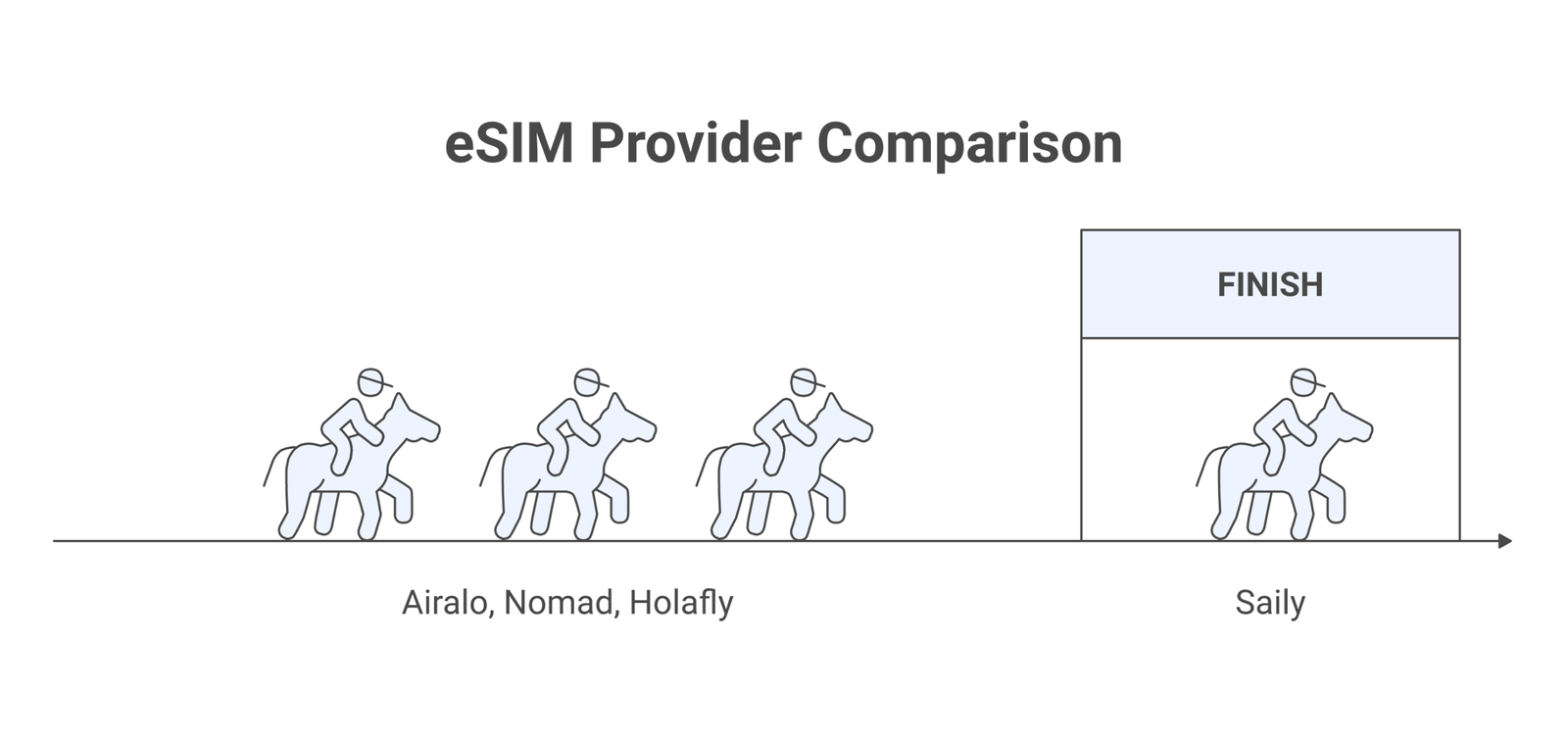
Saily (by the team behind NordVPN) has gained traction recently with competitive pricing starting at $3.99 for basic plans. They provide data usage alerts at 80% capacity, which helps avoid surprises. Their European multi-country plans are particularly good if France is just one stop on a larger trip.
✓ Quick provider comparison
- ✓ Airalo: Best all-rounder, flexible plans, easy top-ups
- ✓ Holafly: Best for unlimited data, partners with Orange France
- ✓ Nomad: Budget-friendly, hotspot sharing included
- ✓ Saily: Cheapest entry plans, multi-country coverage
How to Set Up Your eSIM Before Traveling to France
Setting up an eSIM takes under 10 minutes, and you should do it before you leave home. Here’s the process.
First, confirm your phone supports eSIM. Most iPhones from the XS (2018) onward and Samsung Galaxy phones from the S20 onward support eSIM. Google Pixels have supported it since the Pixel 3. If you’re not sure, check your phone’s settings under “Cellular” or “Mobile Data” and look for an option to add a cellular plan. Apple’s eSIM support page has a full list of compatible iPhones. We also have a detailed guide to activating eSIM on iPhone.
Next, pick a provider and purchase your plan through their app or website. You’ll receive a QR code, either by email or directly in the app. On iPhone, go to Settings > Cellular > Add eSIM > Use QR Code and scan it. On Android, it’s Settings > Network & Internet > SIMs > Add eSIM. The profile downloads in about 30 seconds.
Once installed, label the new plan something obvious like “France Travel” so you can tell it apart from your regular line. Keep your home SIM active for calls and texts if you want, but switch your mobile data to the France eSIM before landing. Most plans activate automatically when they detect a French network.
One thing people get wrong: install the eSIM while you still have WiFi. If you wait until you’re at the airport in France without connectivity, you won’t be able to download the profile. Do it at home or at your hotel before departure. The French telecommunications regulator ARCEP confirms that all three major French carriers now support eSIM technology for visiting devices.
💡 Pro Tip
Take a screenshot of your QR code and save it to your photos before you travel. If you need to reinstall the eSIM for any reason, having the QR code accessible offline is a lifesaver.
Network Coverage Across France
France has some of the best mobile coverage in Europe. The three main carriers, Orange, SFR, and Bouygues Telecom, cover over 99% of the population with 4G. 5G rollout has been aggressive since 2021, with Orange alone covering more than 15,000 municipalities as of early 2026, according to data published by ARCEP’s coverage maps.
In Paris, you’ll have excellent 5G and 4G everywhere, including the Metro (which started getting 4G coverage in stations back in 2012, and full tunnel coverage has expanded significantly). Lyon, Marseille, Bordeaux, Strasbourg, Toulouse, and Nice all have strong coverage. Even in mid-sized towns and villages, 4G is typically available.
Where coverage gets spotty is deep rural France: think small mountain villages in the Pyrenees or remote areas of Corsica and the Massif Central. If your trip includes hiking in these regions, expect occasional dead zones. The French government’s New Deal Mobile program has been addressing rural coverage gaps since 2018, but some isolated spots remain.
For practical purposes, if you’re visiting the major tourist destinations (Paris, the Riviera, Loire Valley, Provence, Normandy beaches), coverage will be solid. Your eSIM will work just as well as a local French SIM card since it connects to the same towers.
How Much Data Do You Actually Need in France?
This depends on what you’re doing, but here are some realistic numbers based on typical tourist usage patterns.
Google Maps navigation uses about 5-10MB per hour. If you’re navigating for two hours a day across a week-long trip, that’s roughly 100-150MB just for maps. Messaging apps like WhatsApp use very little data for text (under 1MB per day for heavy texters), but voice calls use about 1MB per minute and video calls about 5MB per minute. Social media browsing with images eats through 50-100MB per hour depending on how much you scroll.
For a typical tourist spending 7-10 days in France, using maps, messaging, light social media, and occasional web searches, 3-5GB is usually enough. If you’re posting photos and stories constantly, streaming music in the background, or need video calls for work (check our digital nomad travel tech essentials), bump that to 7-10GB. Research from Statista shows the average Western European mobile user consumes about 15GB per month, though tourists tend to use less since they’re often on hotel WiFi in the evenings.
My suggestion: buy slightly more than you think you need. Running out of data mid-trip while trying to find your way to a restaurant in the Marais is not fun. Most providers let you top up, but it’s cheaper per GB to buy a larger plan upfront.
📝 Important Note
France has extensive free WiFi in hotels, cafes, and public spaces. Paris alone has over 1,000 free WiFi hotspots through the city’s “Paris WiFi” program. Use WiFi for heavy downloads and video calls to stretch your eSIM data further.
eSIM vs Other Connectivity Options in France
You have several options for staying connected in France, but they’re not all equal in terms of convenience and cost.
International roaming from your home carrier is the easiest option because you don’t have to do anything. But it’s also the most expensive. US carriers like AT&T charge $10/day for their International Day Pass. T-Mobile includes basic data in some plans, but speeds are throttled to 256kbps, which is barely usable for anything beyond text. If you’re from an EU country, roaming within France is free under the EU’s Roam Like at Home regulation, but this doesn’t help travelers from outside Europe.
Buying a local physical SIM at a French shop (Orange, Free, or SFR) gets you good rates and local coverage. Free Mobile’s tourist SIM offers 100GB for about €20. The downside is you need to find a store, wait in line, and swap your SIM card. If you have a dual-SIM phone, this works, but many travelers don’t want to deal with tiny SIM trays and potentially losing their home SIM. The French consumer protection authority (DGCCRF) requires all SIM vendors to provide clear pricing, so at least you won’t get surprised by hidden fees.
Pocket WiFi rental gives you a portable hotspot that multiple devices can connect to. Companies like Hippocketwifi and My Webspot rent them for about €7-10 per day. The problem is you need to pick it up (usually at the airport or by delivery) and return it when you leave. It’s one more device to charge and carry around.
An eSIM hits the sweet spot: cheaper than roaming, more convenient than physical SIMs, and lighter than pocket WiFi. You install it before you travel, it activates on arrival, and your home number stays active on your physical SIM for incoming calls. For most tourists visiting France, this is the best option.
Using Your eSIM Across France’s Top Destinations
Paris: Full 5G and 4G coverage everywhere. You’ll need data for navigating the Metro (the official RATP app works offline too, but real-time updates need data), booking restaurants on TheFork, and using ride-hailing apps like Uber or Bolt. Skip-the-line tickets for the Louvre and Eiffel Tower are all digital now, so make sure you have your QR codes ready.
French Riviera (Nice, Cannes, Monaco): Coverage is excellent along the coast. Google Maps is essential for driving the winding coastal roads. Note that Monaco is technically a separate country, but most eSIM Europe plans include it. Check your plan’s country list before assuming.
Loire Valley: Good 4G coverage in and around the chateaux towns (Amboise, Blois, Chambord). Some of the smaller roads between castles might have weaker signal, but it’s generally reliable. Download offline maps for the area as a backup.
Provence and the Lavender Fields: Coverage is strong in Avignon, Aix-en-Provence, and most towns. The more remote lavender fields near Valensole can have patchy signal, but you’ll have connectivity in nearby villages.
Normandy (D-Day beaches, Mont Saint-Michel): Good 4G coverage. Mont Saint-Michel and the surrounding area have been upgraded with better cell towers due to tourist volume. The D-Day beaches along the coast have reliable signal for using audio tour apps. The Normandy tourism board offers a useful companion app that works best with mobile data.
French Alps (Chamonix, Annecy): Towns and ski resorts have solid coverage. Higher altitude trails and backcountry areas will lose signal. If you’re skiing, most resorts have WiFi in lodges and restaurants.
Saving Money on Your France eSIM
A few practical ways to get more value from your eSIM plan in France.
Download offline maps before you leave. Google Maps and Apple Maps both let you save specific areas for offline use. This alone can cut your data usage by 30-40% since map tiles are one of the biggest data consumers. For Paris specifically, download the entire Ile-de-France region.
Use WiFi for heavy tasks. French hotels almost universally offer free WiFi (it’s expected, not a premium amenity like in some countries). Cafes, restaurants, and even many public spaces have free networks. Save your eSIM data for when you’re out exploring, and do your photo uploads and video calls on WiFi. According to France’s official tourism website, free public WiFi is available in most major tourist areas.
If you’re visiting France as part of a multi-country European trip, buy a regional eSIM plan instead of a France-only one. Airalo’s Europe plan covers 39 countries, and the per-GB cost is often similar to single-country plans. This way you avoid buying separate eSIMs for each destination. The European Commission’s connectivity policies have made cross-border mobile services increasingly seamless.
Turn off automatic app updates and cloud photo backup over cellular data. These background processes can eat through gigabytes without you noticing. On iPhone, go to Settings > App Store > turn off “App Updates” under Cellular Data. On Android, open Google Play > Settings > Network preferences > set to “WiFi only.”
✓ Data-saving checklist for France
- ✓ Download offline maps for your destinations
- ✓ Turn off cellular auto-updates on your phone
- ✓ Disable cloud photo backup on mobile data
- ✓ Use hotel and cafe WiFi for uploads and streaming
- ✓ Set data usage alerts in your eSIM provider’s app
Common Issues and How to Fix Them
eSIM won’t activate after landing: Make sure data roaming is turned on for the eSIM line. On iPhone: Settings > Cellular > tap the eSIM plan > turn on Data Roaming. This is the most common issue tourists face. Also verify the eSIM is set as your default data line, not your home SIM.
Slow speeds in busy areas: Tourist hotspots like the Champs-Elysees, the area around the Eiffel Tower, and Nice’s Promenade des Anglais can get congested during peak hours. If speeds drop, try toggling airplane mode on and off to reconnect to a less congested tower. The FCC’s guide on international travel notes that network congestion is a temporary issue in popular tourist zones worldwide.
Can’t receive calls on home number: eSIM data plans are data-only. They don’t give you a French phone number or voice calling capability (some providers offer this, but most tourist plans don’t). Your home SIM stays active for calls and texts. If you need to make local calls in France, use WhatsApp, FaceTime, or Skype over your eSIM data.
Data ran out: Most providers have an app where you can buy additional data. Airalo and Saily let you top up directly. If your provider doesn’t support top-ups, you can purchase a second eSIM from a different provider and install it alongside the first one. Modern phones like the iPhone 15 and 16 support multiple eSIM profiles. Google’s Android support pages have instructions for managing multiple eSIM profiles.
Phone says “No Service” intermittently: Check that your phone’s software is up to date. Carrier settings updates occasionally fix eSIM connectivity bugs. If the issue persists, manually select a network: Settings > Cellular > Network Selection > turn off Automatic > choose Orange, SFR, or Bouygues from the list.
What About EU Roaming Rules?
If you already have a European SIM card or eSIM, you might not need a separate France eSIM at all. Under the EU’s Roam Like at Home regulation, which has been in effect since June 2017, you can use your home country’s mobile plan in any EU member state at no extra cost. This applies to calls, texts, and data.
So if you’re a German tourist with a Telekom plan, or a Spanish traveler with Movistar, your existing plan works in France exactly as it does at home. The European Commission’s roaming page explains the full details, including fair usage limits that prevent abuse of the policy.
There are some limits. If you’re on a very cheap plan, your carrier might cap the data you can use abroad. The formula is based on the wholesale roaming rate (currently €1.55 per GB in 2026, scheduled to drop further), and your carrier must provide a minimum amount of data based on your plan’s retail price. In practice, most European plans give you at least 10-15GB of roaming data per month.
For travelers from the UK (post-Brexit), Switzerland, or non-EU countries, these rules don’t apply. UK carriers reintroduced roaming charges in 2022, and while some still offer inclusive EU roaming on premium plans, you should check before assuming. A France-specific eSIM is almost always cheaper than UK roaming add-ons. The UK’s Ofcom tracks which British carriers still include EU roaming.
⚠️ Disclaimer
Pricing, coverage, and carrier policies mentioned in this article are based on information available as of March 2026. eSIM providers frequently update their plans and pricing. Always check the provider’s website for the most current rates before purchasing.
Frequently Asked Questions
Do I need to unlock my phone to use an eSIM in France?
Yes. If your phone is locked to a specific carrier, you won’t be able to install a third-party eSIM. Contact your carrier to unlock it before your trip. Most carriers will unlock phones that are fully paid off. In the US, the FCC requires carriers to unlock devices within one business day of receiving a valid request.
Can I use my eSIM in Monaco when traveling from France?
It depends on your plan. Most European or multi-country eSIM plans include Monaco, but some France-only plans don’t since Monaco is a separate country. Check your provider’s coverage list. Airalo and Holafly’s Europe plans both include Monaco.
Will my eSIM work in the Paris Metro underground?
Yes, mostly. RATP and the major carriers have been installing 4G equipment in Metro stations and tunnels since 2012. Coverage is available in most stations and on many tunnel sections, though some of the older Line 3bis and 7bis segments can still have gaps. You’ll have full signal at every station platform.
How long does a France eSIM plan last?
Validity periods range from 7 to 30 days depending on the provider and plan you choose. The countdown typically starts when the eSIM first connects to a French network, not when you purchase it. So you can buy and install your eSIM weeks before your trip without wasting days.
Can I share my eSIM data via hotspot?
Some providers allow hotspot/tethering and some don’t. Nomad and Holafly generally allow it, while Airalo’s policy varies by plan. Check the plan details before purchasing if hotspot sharing is important to you, especially if you’re traveling with companions whose phones don’t support eSIM.
Is 5G available through eSIM in France?
Some eSIM providers offer 5G access in France, but it’s not universal. Holafly’s France plans support 5G where available. Airalo is gradually rolling out 5G support. If 5G matters to you, confirm with the provider before buying. That said, France’s 4G network is fast enough for any typical tourist use, with average speeds around 40-60 Mbps in cities.