
Why You Need an eSIM for Africa Travel
Traveling across Africa without reliable mobile data is a recipe for frustration. Whether you’re navigating Nairobi’s traffic, booking a safari guide in Tanzania, or trying to use mobile payments in Kenya (where M-Pesa handles over 60% of transactions), you need connectivity. An eSIM for Africa solves this without the hassle of hunting for local SIM cards at airports or dealing with sketchy reseller kiosks.
The reality is that Africa’s 54 countries have wildly different telecom landscapes. South Africa has solid 4G/LTE coverage through Vodacom and MTN. Morocco and Egypt are well connected. But coverage gets patchy once you venture into rural areas of the Sahel, Central Africa, or East African highlands. An eSIM lets you buy the right plan before you even land, compare providers from your couch, and switch plans if coverage disappoints you.
If you’re new to the technology, our beginner’s guide to eSIM covers how it all works. For this article, we’ll focus specifically on which providers actually deliver in Africa, what coverage looks like on the ground, and how to avoid overpaying for data you won’t use.
Africa’s mobile coverage landscape in 2026
Africa’s mobile infrastructure has improved dramatically over the past five years. According to the GSMA’s Mobile Economy report, Sub-Saharan Africa reached over 670 million mobile subscribers by the end of 2025, with 4G connections growing faster than any other region globally. North Africa, including Morocco, Tunisia, and Egypt, has even stronger coverage with 5G rollouts underway in major cities.
That said, coverage varies enormously by country. Here’s a practical breakdown:
✓ Countries with strong eSIM coverage
- ✓ South Africa: 4G/LTE in all major cities, expanding 5G in Johannesburg, Cape Town, Durban
- ✓ Kenya: Strong 4G coverage via Safaricom across Nairobi, Mombasa, and tourist areas
- ✓ Morocco: Excellent coverage nationwide, 5G launching in Casablanca and Rabat
- ✓ Egypt: Solid 4G along the Nile Valley, Red Sea resorts, and Cairo
- ✓ Nigeria: 4G in Lagos, Abuja, Port Harcourt (spotty elsewhere)
- ✓ Tanzania: Good coverage in Dar es Salaam, Arusha, and Zanzibar
- ✓ Ghana: Reliable 4G in Accra and major towns
Countries like Chad, Central African Republic, South Sudan, and parts of the DRC still have limited 3G coverage at best. If you’re heading to remote areas in these countries, don’t count on mobile data alone. The ITU’s broadband statistics show that mobile broadband penetration in Central Africa remains below 25%, compared to over 60% in North Africa.
For safari-goers specifically, coverage inside national parks depends on the country. Kenya’s Masai Mara has decent Safaricom coverage. Tanzania’s Serengeti is patchier, with signal mainly near lodges and ranger stations. Botswana’s Okavango Delta has almost no coverage. Plan accordingly.
Best eSIM providers for Africa in 2026
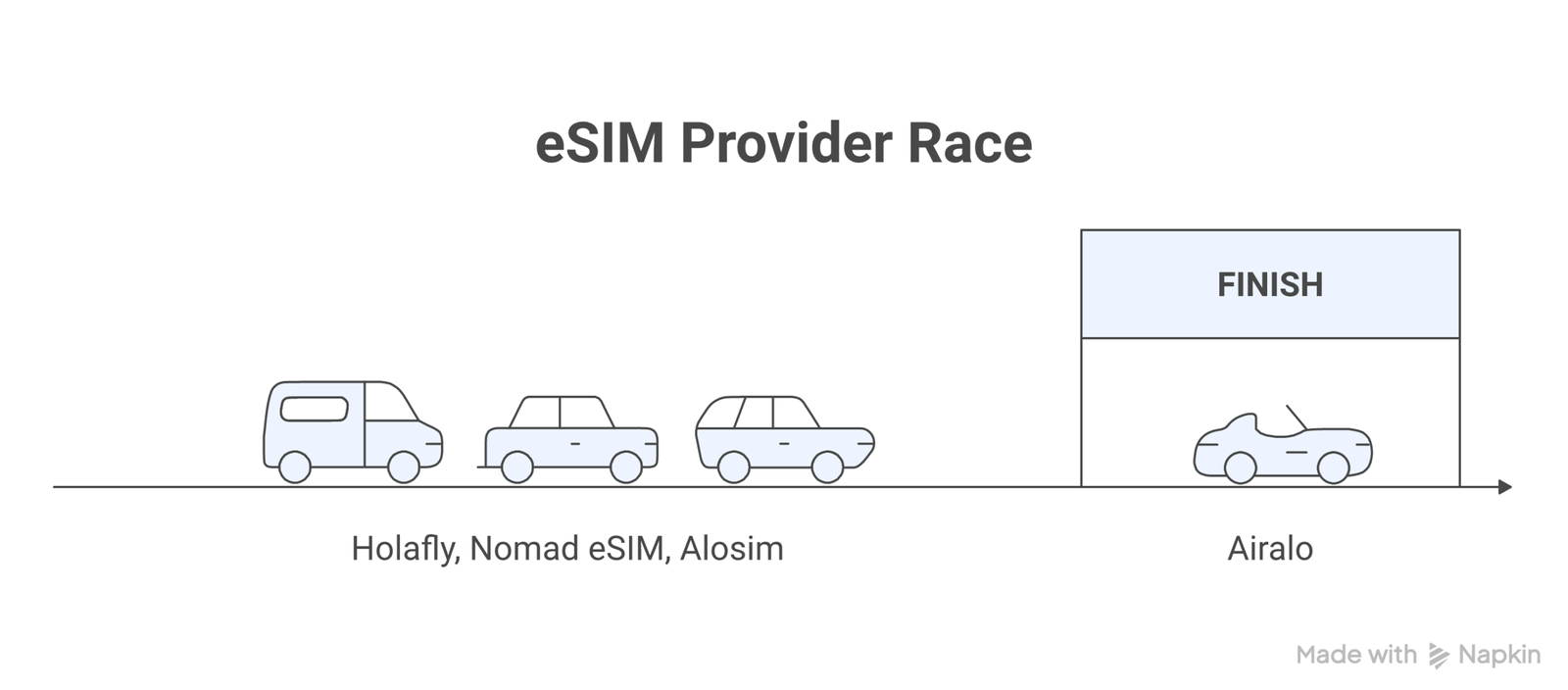
Not all eSIM providers treat Africa equally. Some cover 40+ African countries, others barely manage 10. After comparing the major players, here are the ones worth your money for African travel.
1. Airalo
Airalo remains the most popular eSIM marketplace for African travel, and for good reason. They offer both country-specific plans (for South Africa, Kenya, Egypt, Morocco, Nigeria, Ghana, Tanzania, and about 20 others) and a regional “Africa” plan covering 30+ countries. The regional plan starts at $5 for 1 GB with 7-day validity, which is reasonable for short visits.
Where Airalo shines is coverage breadth. If you’re doing a multi-country trip through East Africa or hopping between West African capitals, their regional plan saves you from buying separate eSIMs for each country. The app is clean, activation takes about two minutes, and their support is responsive. We compared Airalo against other providers in our global eSIM providers comparison.
2. Holafly
Holafly offers unlimited data plans for several African countries including South Africa, Morocco, Egypt, and Turkey (for those combining Africa and Middle East travel). Their unlimited plans are time-based rather than data-capped, which is great if you need to video call, stream maps, or upload photos constantly.
The catch? Their African coverage is narrower than Airalo’s. Holafly focuses on the most popular tourist destinations and skips smaller or less-visited countries. If you’re going to South Africa, Morocco, or Egypt specifically, Holafly’s unlimited option can be more cost-effective than buying capped data from competitors.
3. Nomad eSIM
Nomad provides competitive pricing for Africa with both local and regional plans. Their Africa regional plan covers around 25 countries. Pricing sits between Airalo and Holafly, and they occasionally run promotions that bring costs down further.
Nomad’s interface is straightforward, and they support data sharing via hotspot on most plans, which not every provider allows. If you’re traveling with a partner and only one of you has an eSIM-compatible phone, this hotspot feature can be genuinely useful.
4. Alosim
Alosim (formerly known as Aloha Mobile) covers a growing number of African destinations. Their per-GB pricing can undercut larger competitors, especially for countries like Kenya and South Africa where they have direct carrier agreements. Worth checking for single-country plans where you need more than 5 GB.
💡 Pro tip
Before buying, check whether your phone supports eSIM. Most iPhones from the XS onwards and Samsung Galaxy S20+ and later work fine. Our eSIM vs physical SIM comparison covers device compatibility in detail. You can also check your specific model on the Apple cellular page or Samsung’s eSIM guide.
How to choose the right eSIM plan for Africa
Picking an eSIM plan for Africa comes down to three questions: how many countries are you visiting, how long are you staying, and how much data do you actually use?
Single-country trips (like a week in Morocco or two weeks in South Africa): Buy a country-specific plan. They’re cheaper per GB than regional plans and often connect to the best local carrier. A 5 GB plan for 15 days typically costs $8-15 depending on the provider and country.
Multi-country trips (like an East Africa circuit through Kenya, Tanzania, and Rwanda): Go with a regional Africa plan. Yes, you pay a slight premium per GB, but you avoid the headache of managing multiple eSIM profiles. Regional plans usually cover 25-40 African countries under one subscription.
Long-term stays (a month or more): Consider a larger data plan upfront. Buying a 10-20 GB plan is almost always cheaper than topping up smaller plans repeatedly. For stays over 60 days, you might actually save money by picking up a local physical SIM instead, since local prepaid rates in countries like South Africa and Kenya are very competitive.
📝 Important note about data usage
Navigation apps like Google Maps and Maps.me use about 5-10 MB per hour of active navigation. Messaging (WhatsApp, Telegram) uses very little. Video calls eat 300-500 MB per hour. Download offline maps before you go and you’ll stretch a 3 GB plan much further than you’d expect.
Setting up your eSIM before arriving in Africa
One of the biggest advantages of an eSIM for Africa is that you can set everything up at home before your flight. No more scrambling at Jomo Kenyatta International Airport trying to find a SIM vendor, or hoping the shop at O.R. Tambo is open when your red-eye lands at 5 AM.
The setup process takes about two minutes regardless of which provider you choose:
1. Purchase your eSIM plan through the provider’s app or website
2. Scan the QR code or enter the activation details manually (on iPhone, go to Settings > Cellular > Add eSIM)
3. Label the plan something obvious like “Africa Data”
4. Keep your home SIM as the default for calls/texts, set the new eSIM as default for data
5. Enable the data plan once you land
If you need step-by-step instructions with screenshots, our iPhone eSIM activation guide walks through the whole process. For Android users, the process is similar through Settings > Network & Internet > SIMs.
Country-by-country eSIM coverage breakdown
Africa has 54 recognized countries, and eSIM coverage varies significantly across them. Here’s what to expect in the most visited destinations.
East Africa
Kenya has some of Africa’s best mobile infrastructure thanks to Safaricom, which covers about 96% of the population with 4G. You’ll have signal in Nairobi, along the coast, and in most game reserves. eSIM providers typically connect through Safaricom’s network here.
Tanzania has strong coverage in Dar es Salaam, Arusha, and Zanzibar. Serengeti coverage exists but is inconsistent. Kilimanjaro climbers report losing signal above the rainforest zone (around 3,000m). The main carriers are Vodacom Tanzania and Airtel.
Rwanda punches above its weight. MTN Rwanda provides solid 4G coverage across most of this small, densely populated country. Kigali has fast internet by any standard.
Uganda has good coverage in Kampala and along major highways, but rural and western Uganda (including some gorilla trekking areas) can be unreliable.
Southern Africa
South Africa is the continent’s leader in mobile coverage. Vodacom and MTN both offer extensive 4G networks, and 5G is available in parts of Johannesburg, Cape Town, and Durban. You’ll have signal on highways, in national parks, and in most towns. Even the Kruger National Park has reasonable coverage near camps and main roads.
Botswana has decent coverage in Gaborone, Maun, and Kasane, but the Okavango Delta and Kalahari Desert have minimal signal. Safari lodges in remote areas usually provide Wi-Fi, so plan around that.
Namibia covers its main corridors (Windhoek to Swakopmund, the B1/B2 highways) reasonably well, but huge stretches of desert between towns have no coverage at all. MTC Namibia is the primary carrier.
North Africa
Morocco offers excellent coverage through Maroc Telecom, Orange Morocco, and Inwi. You’ll have 4G in all cities, most towns, and along major routes. Even the Sahara desert tours from Merzouga usually have some signal for parts of the journey.
Egypt has solid coverage along the Nile, in Cairo, Alexandria, and all Red Sea resort areas (Hurghada, Sharm el-Sheikh). Coverage thins out in the Western Desert. Vodafone Egypt and Orange Egypt are the main carriers.
West Africa
Ghana has good 4G in Accra and major cities, with coverage expanding. Senegal covers Dakar and the western regions well. Nigeria has coverage in Lagos, Abuja, and state capitals, but the network quality is inconsistent and congestion can slow things down during peak hours. MTN Group operates across most West African countries and is typically the carrier eSIM providers connect through.
Pricing comparison: eSIM vs alternatives for Africa
How does an eSIM stack up against other connectivity options for African travel? Let’s compare real costs.
International roaming from US and European carriers typically costs $10-15 per day in Africa. A two-week trip means $140-210 just for data. Most plans throttle you to 2G speeds after a few hundred MB per day. That’s expensive and slow.
Local SIM cards are the cheapest option if you don’t mind the hassle. A prepaid SIM in Kenya (Safaricom) costs about $2-3 with 1 GB included. South Africa’s prepaid data is similarly cheap. But you need to find a shop, potentially show your passport, and deal with registration requirements that some countries have tightened in recent years.
eSIM plans fall in the middle. A typical 5 GB, 15-day Africa regional plan costs $15-25 depending on the provider. Country-specific plans are cheaper. You won’t match local SIM pricing, but you save time, skip the registration bureaucracy, and can set up before departure.
For a detailed comparison of these options, check our digital nomad travel tech guide which covers connectivity strategies for extended travel.
Tips for getting the most from your Africa eSIM
A few practical tips based on real travel experience across the continent:
Download offline maps first. Google Maps and Maps.me both let you save regions for offline use. Do this on your hotel Wi-Fi and you’ll barely need mobile data for navigation. This is especially important in countries with patchy coverage.
Disable automatic updates and cloud sync. Your phone will happily burn through 2 GB uploading photos to iCloud while you’re trying to conserve data. Turn off automatic uploads until you’re on Wi-Fi.
Check the APN settings. If your eSIM connects but data doesn’t flow, the Access Point Name (APN) might need manual configuration. Your eSIM provider should include these details, but Apple’s cellular settings guide can help if you get stuck. Our eSIM troubleshooting guide also covers common setup problems.
Use Wi-Fi calling when available. Many hotels, restaurants, and co-working spaces in African cities have decent Wi-Fi. Switch to Wi-Fi calling and save your eSIM data for when you’re on the move.
Consider a backup plan. If you’re going somewhere truly remote (like the Danakil Depression in Ethiopia or a multi-day Okavango mokoro trip), accept that you’ll be offline. Let someone know your itinerary and don’t rely solely on mobile connectivity for safety. A satellite communicator might be worth the investment for genuinely remote trips.
⚠️ Disclaimer
eSIM coverage, pricing, and carrier availability change frequently. The information in this article reflects conditions as of March 2026. Always verify coverage maps and pricing directly with your chosen eSIM provider before purchasing. We are not affiliated with any of the providers mentioned.
Frequently Asked Questions
Does eSIM work across all African countries?
No. Most eSIM providers cover 20-40 African countries, focusing on popular tourist destinations and countries with developed telecom infrastructure. Central African nations and some island states may not be covered. Always check your provider’s coverage map for specific countries before purchasing.
Can I use an eSIM on safari in Africa?
It depends on the location. Popular parks like Kruger (South Africa), Masai Mara (Kenya), and Serengeti (Tanzania) have mobile coverage in many areas, though signal can drop in remote sections. More remote destinations like Okavango Delta (Botswana) or Hwange (Zimbabwe) have very limited coverage. Most safari lodges provide Wi-Fi.
What’s the cheapest eSIM option for Africa?
For single-country trips, Airalo’s country-specific plans start at $4.50 for 1 GB. For multi-country travel, regional plans start around $5-8 for 1 GB. The cheapest option overall is still a local prepaid SIM ($2-5 for several GB), but an eSIM saves time and hassle.
Will my eSIM work with phone calls and SMS in Africa?
Most travel eSIMs are data-only plans. You won’t get a local phone number for calls and texts. However, you can make calls through WhatsApp, Telegram, or other VoIP apps using your data connection. Some providers like Holafly offer plans that include calling minutes, but these cost more.
How much data do I need for a two-week Africa trip?
For typical tourist use (messaging, maps, social media, occasional video calls), 3-5 GB is usually enough for two weeks if you use Wi-Fi at hotels. Heavy users who stream video or upload lots of photos should budget 8-10 GB or look at unlimited plans from Holafly.