
Which Phones Support eSIM in 2026?
If you’re shopping for a new phone or planning an international trip, you probably want to know whether your device supports eSIM. The good news: most smartphones released since 2022 include eSIM capability, and the list keeps growing. This guide covers every eSIM compatible phone available in 2026, organized by brand, so you can quickly check whether your device makes the cut.
eSIM technology lets you activate a cellular plan without inserting a physical SIM card. Instead, your carrier provisions a digital profile directly to a chip built into the phone. For travelers, this means you can buy a local data plan before you even land. For everyone else, it means fewer trips to the carrier store and easier switching between plans.
📺 Video Guide
Apple iPhones with eSIM support
Apple was one of the first major manufacturers to adopt eSIM, starting with the iPhone XS in 2018. Since then, every new iPhone model has included eSIM support. The iPhone 14 and later models sold in the United States are eSIM-only, with no physical SIM tray at all.
Full list of eSIM compatible iPhones:
- iPhone 16 Pro Max, iPhone 16 Pro, iPhone 16 Plus, iPhone 16
- iPhone 15 Pro Max, iPhone 15 Pro, iPhone 15 Plus, iPhone 15
- iPhone 14 Pro Max, iPhone 14 Pro, iPhone 14 Plus, iPhone 14 (US models: eSIM only)
- iPhone SE (3rd generation, 2022)
- iPhone 13 Pro Max, iPhone 13 Pro, iPhone 13 mini, iPhone 13
- iPhone 12 Pro Max, iPhone 12 Pro, iPhone 12 mini, iPhone 12
- iPhone 11 Pro Max, iPhone 11 Pro, iPhone 11
- iPhone XS Max, iPhone XS, iPhone XR
iPhones from the XS onward support dual SIM via one nano-SIM and one eSIM. The iPhone 13 and later can store multiple eSIM profiles simultaneously, and the iPhone 16 series supports up to eight eSIM profiles (though only two can be active at once).
💡 Pro Tip
If you bought your iPhone in China (mainland), it will not support eSIM regardless of the model. Apple uses dual physical SIM trays for the Chinese market instead.
Samsung Galaxy phones with eSIM support
Samsung has been adding eSIM support across its Galaxy lineup since 2020, starting with the Galaxy S20 series. Today, most of Samsung’s flagship and mid-range phones include eSIM.
Galaxy S series:
- Galaxy S25 Ultra, Galaxy S25+, Galaxy S25
- Galaxy S24 Ultra, Galaxy S24+, Galaxy S24, Galaxy S24 FE
- Galaxy S23 Ultra, Galaxy S23+, Galaxy S23, Galaxy S23 FE
- Galaxy S22 Ultra, Galaxy S22+, Galaxy S22
- Galaxy S21 Ultra 5G, Galaxy S21+ 5G, Galaxy S21 5G
- Galaxy S20 Ultra 5G, Galaxy S20+ 5G, Galaxy S20 5G
Galaxy Z series (foldables):
- Galaxy Z Fold 6, Galaxy Z Flip 6
- Galaxy Z Fold 5, Galaxy Z Flip 5
- Galaxy Z Fold 4, Galaxy Z Flip 4
- Galaxy Z Fold 3, Galaxy Z Flip 3
Galaxy A series (mid-range):
- Galaxy A56, Galaxy A36, Galaxy A26
- Galaxy A55 5G, Galaxy A35 5G, Galaxy A25 5G
- Galaxy A54 5G
One thing to watch out for: Samsung’s eSIM availability varies by region and carrier. A Galaxy S24 purchased from one carrier might have eSIM enabled, while the same model from another carrier might not. Always check with your specific carrier or buy the unlocked version to guarantee eSIM access.
Google Pixel phones with eSIM support
Google was actually ahead of Apple here. The Pixel 2 supported eSIM back in 2017, though it was limited to Google Fi. Since the Pixel 3a, Google has opened eSIM support to more carriers.
- Pixel 9 Pro XL, Pixel 9 Pro, Pixel 9 Pro Fold, Pixel 9
- Pixel 8 Pro, Pixel 8a, Pixel 8
- Pixel 7 Pro, Pixel 7a, Pixel 7
- Pixel 6 Pro, Pixel 6a, Pixel 6
- Pixel 5a 5G, Pixel 5
- Pixel 4a 5G, Pixel 4a, Pixel 4 XL, Pixel 4
- Pixel 3a XL, Pixel 3a, Pixel 3 XL, Pixel 3
- Pixel 2 XL, Pixel 2 (Google Fi only)
The Pixel 9 series supports dual eSIM, meaning you can run two eSIM profiles at the same time without a physical SIM card. This is particularly useful for travelers who want to keep their home number active while using a local data plan.
Motorola phones with eSIM support
Motorola has steadily expanded eSIM support across its Razr and Edge lines:
- Motorola Razr+ (2024), Motorola Razr (2024)
- Motorola Razr+ (2023), Motorola Razr (2023)
- Motorola Razr 5G (2020)
- Motorola Edge 50 Ultra, Edge 50 Pro, Edge 50 Fusion
- Motorola Edge+ (2023), Edge (2023)
- Motorola Edge 40 Pro, Edge 40 Neo
The Razr foldables have been eSIM compatible since the 5G model in 2020, making them solid picks for travelers who want a compact phone with flexible connectivity.
OnePlus, Xiaomi, and other brands
Chinese manufacturers have been slower to adopt eSIM for smartphones (partly because eSIM adoption in China itself is limited), but that’s changing quickly.
OnePlus:
- OnePlus 13, OnePlus 13R
- OnePlus 12, OnePlus 12R
- OnePlus Open (foldable)
Xiaomi:
- Xiaomi 15 Pro, Xiaomi 15
- Xiaomi 14 Ultra, Xiaomi 14 Pro, Xiaomi 14
- Xiaomi 13 Pro, Xiaomi 13
- Xiaomi Mix Fold 4, Mix Flip
Other brands with eSIM support:
- Sony: Xperia 1 VI, Xperia 1 V, Xperia 5 V, Xperia 10 VI
- Oppo: Find X8 Pro, Find X7 Ultra, Find N3
- Nothing: Phone (2a), Phone (2)
- Huawei: P60 Pro, Mate 60 Pro (limited regional support)
- Honor: Magic6 Pro, Magic V3
Regional availability is the biggest variable here. A GSMArena spec check for your specific model number will confirm whether your variant has eSIM hardware enabled.
✓ Quick compatibility check
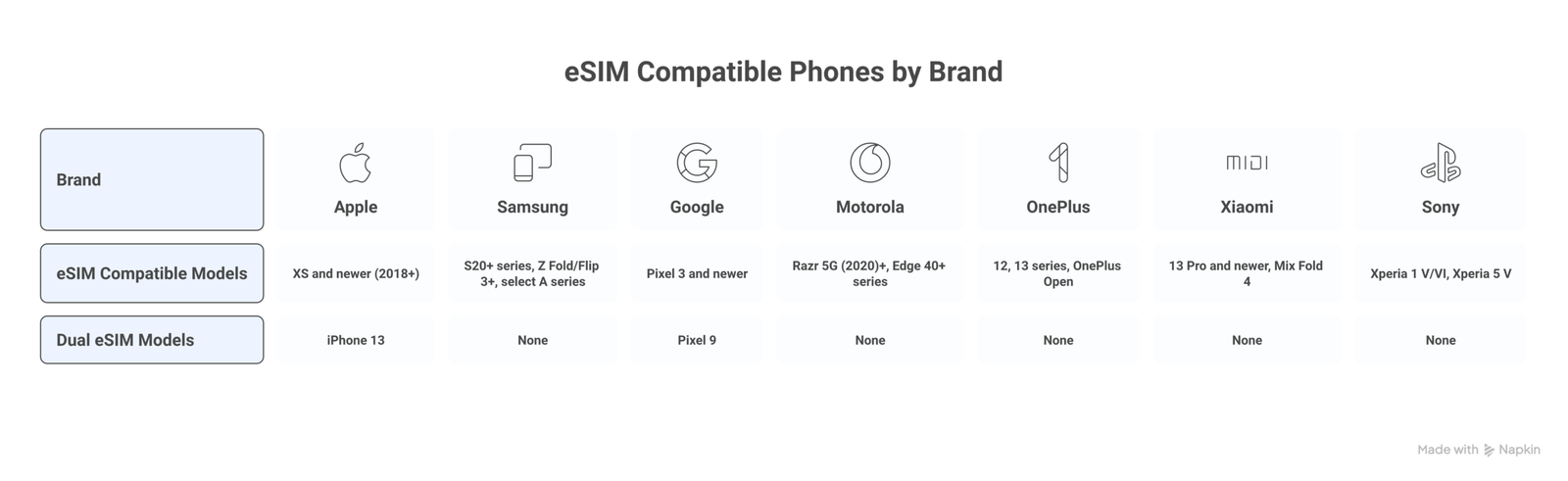
- ✓ iPhone: Any model from XS (2018) or newer
- ✓ Samsung: Galaxy S20 or newer, Z Fold/Flip 3 or newer, select A series
- ✓ Google: Pixel 3 or newer (Pixel 2 limited to Google Fi)
- ✓ Motorola: Razr 5G (2020) or newer, Edge 40+ series
- ✓ OnePlus: 12 or newer, OnePlus Open
Tablets and laptops with eSIM support
eSIM isn’t limited to smartphones. Many tablets, laptops, and even smartwatches now include eSIM support.
Apple iPads with eSIM:
- iPad Pro (M4, M2, M1, and 3rd/4th generation WiFi + Cellular models)
- iPad Air (M2, M1, 4th/5th generation WiFi + Cellular)
- iPad (10th, 9th, 8th, 7th generation WiFi + Cellular)
- iPad mini (6th, 5th generation WiFi + Cellular)
Windows laptops with eSIM:
- Microsoft Surface Pro 10, Surface Pro 9 5G, Surface Go 4
- Lenovo ThinkPad X1 Carbon (Gen 11/12), ThinkPad X13s
- HP Elite Dragonfly G4, HP Spectre x360 (select models)
- Dell Latitude 7340, Latitude 5540 (with WWAN option)
- Samsung Galaxy Book4 Pro 360 (5G models)
For laptops, eSIM usually requires the WWAN (cellular) configuration option. The base WiFi-only model won’t have the eSIM chip even if the product line supports it. Check the specific configuration before purchasing.
How to check if your phone supports eSIM
Not sure if your specific phone has eSIM? Here’s how to verify on each platform:
On iPhone: Go to Settings > General > About. Look for “Available SIM” or “Digital SIM.” If you see an option to “Add eSIM” or “Add Cellular Plan,” your phone supports it. You can also dial *#06# and look for an EID number, which confirms eSIM hardware is present.
On Android (Samsung): Go to Settings > Connections > SIM Manager. If you see an “Add eSIM” option, you’re good. You can also find the EID under Settings > About Phone > Status Information.
On Android (Google Pixel): Go to Settings > Network & Internet > SIMs. If “Download a SIM instead?” appears, your Pixel supports eSIM.
On any Android phone: Dial *#06#. If an EID (32-digit number) appears alongside your IMEI, your device has eSIM hardware.
📝 Important Note
Having eSIM hardware doesn’t always mean it’s enabled. Some carriers lock the eSIM on subsidized phones. If your phone has the hardware but you can’t add an eSIM plan, contact your carrier to ask about unlocking it.
eSIM compatible phones for travelers: what to look for
If you’re buying a phone specifically for travel, here are the specs that matter for eSIM use:
Multiple eSIM profile storage. Phones like the iPhone 15/16 and Pixel 9 can store eight or more eSIM profiles. This is useful if you travel to different countries regularly, since you can keep each destination’s plan saved and just activate the right one when you land.
Dual active SIM support. Most modern eSIM phones support DSDS (Dual SIM Dual Standby), meaning you can have two lines active at once. Keep your home number on one line for calls and texts, and use a local eSIM data plan on the other.
Carrier unlocked. This is the biggest factor. An unlocked phone will work with any eSIM provider worldwide. Carrier-locked phones may restrict which eSIM profiles you can install. If you’re planning to use services like Airalo, Holafly, or Nomad, make sure your phone is unlocked first.
5G band support. If you want fast data speeds abroad, check that your phone supports the 5G bands used in your destination country. Band compatibility varies by region, and a phone purchased in the US may not hit all the 5G frequencies used in Europe or Asia.
Phones without eSIM: what are your options?
If your phone doesn’t support eSIM, you’re not completely out of luck. Here are some alternatives:
Buy a local SIM card. The traditional approach still works. Pick up a prepaid SIM at the airport or a local shop. The downside is you need to swap your existing SIM out, and some destinations charge steep tourist prices at airports.
Use a portable WiFi hotspot with eSIM. Devices like the GlocalMe or Skyroam have built-in eSIM and can share a data connection with your phone over WiFi. Useful if you’re traveling with multiple people.
Upgrade your phone. If you’re using a phone from 2019 or earlier, you’re likely missing eSIM. Check our best eSIM apps guide once you have a compatible device. Given that most phones from the last three years include it, upgrading might be worth it for the travel convenience alone.
What’s changing with eSIM in 2026 and beyond
The eSIM landscape is shifting fast. The GSMA reported that eSIM connections worldwide are expected to exceed 6 billion by 2028, up from around 1.2 billion in 2023. Here’s what’s driving that growth:
More countries are requiring carriers to support eSIM. The European Commission pushed for mandatory eSIM support as part of broader digital connectivity regulations, and several Asian and South American markets are following suit.
iSIM (Integrated SIM) is the next step. Instead of a separate eSIM chip, iSIM technology bakes the SIM function directly into the phone’s main processor. Qualcomm and Samsung have both demonstrated working iSIM implementations. This will make SIM functionality available in even cheaper devices, including IoT sensors and budget phones.
The trend is clear: physical SIM trays are disappearing. Apple already removed them from US iPhones. Samsung and Google are expected to follow within the next two years for select markets.
⚠️ Disclaimer
Device compatibility and eSIM availability can vary by region, carrier, and firmware version. The lists in this article are based on manufacturer specifications available as of March 2026. Always verify with your carrier or the manufacturer’s support page for your specific model variant before purchasing an eSIM plan.
Frequently Asked Questions
How many eSIMs can I have on my phone at the same time?
Most modern phones can store 8 or more eSIM profiles, but only 1 or 2 can be active simultaneously. For example, the iPhone 16 stores up to 8 eSIMs but keeps 2 active at once. You can switch between stored profiles in your phone’s settings without deleting and re-downloading them.
Can I use eSIM if my phone is carrier-locked?
It depends on the carrier. Some carriers allow eSIM profiles from other providers even on locked devices, while others restrict eSIM to their own plans only. Contact your carrier to check. In many countries, carriers are legally required to unlock phones after the contract period ends.
Will my eSIM transfer if I reset my phone?
A factory reset typically deletes all eSIM profiles from your phone. On iPhone, you can choose to keep or erase eSIM profiles during the reset process. On Android, it varies by manufacturer. Always check before resetting, and keep your eSIM QR code or activation details saved somewhere safe.
Do eSIM compatible phones work in every country?
The phone hardware works globally, but eSIM service availability depends on local carriers. Most of Europe, North America, Japan, South Korea, Australia, and parts of Southeast Asia have strong eSIM carrier support. Some countries in Africa and South America have limited options. Check an eSIM provider like Airalo or Holafly to see which plans are available for your destination.
Is eSIM more secure than a physical SIM card?
In some ways, yes. An eSIM can’t be physically removed and swapped into another device, which reduces the risk of SIM theft or SIM swap fraud. The eSIM profile is also encrypted and tied to the specific device. That said, eSIM is still vulnerable to social engineering attacks where someone convinces your carrier to transfer your number.