
Why Unlimited Data eSIM Plans Matter for Travelers
Running out of mobile data mid-trip is one of those travel headaches nobody wants. You’re trying to pull up directions in an unfamiliar city, video-call your family back home, or upload photos from a stunning hike, and suddenly your plan hits its cap. That’s where unlimited data eSIM plans come in. They let you use as much data as you want without worrying about overages or throttling surprises.
The GSMA reports that eSIM adoption is accelerating worldwide, and providers are responding with more generous data packages. In this guide, we compare the best eSIM providers offering unlimited data plans in 2026, break down real-world performance, and help you pick the right one for your next trip.
📺 Video Guide
What “Unlimited Data” Actually Means with eSIMs
Before diving into specific providers, let’s clear up what “unlimited” means in practice. Most unlimited data eSIM plans fall into two categories:
Truly unlimited (no throttling): You get full-speed data for the entire plan duration. These are rare and tend to cost more, but they exist. Holafly is one provider that offers this type for many destinations.
Unlimited with a fair-use cap: You get a generous high-speed data allowance (say 20-50 GB), and after crossing that threshold, speeds drop to 512 Kbps or lower. Providers like Airalo and Nomad eSIM sometimes use this model. For most travelers, you’ll never hit the cap during a two-week trip, but it’s worth knowing the fine print.
The FCC’s broadband speed guide recommends at least 25 Mbps for HD streaming. Most unlimited eSIM plans deliver between 10-50 Mbps on 4G/LTE, which is plenty for navigation, social media, and video calls.
💡 Pro Tip
Always check whether “unlimited” includes hotspot/tethering. Some plans restrict tethering even when on-device data is unlimited. If you plan to share your connection with a laptop or travel companion, confirm tethering is included before you buy.
Top Unlimited Data eSIM Providers Compared
We tested and compared five providers that currently offer unlimited or near-unlimited data eSIM plans across multiple regions. Here’s how they stack up.
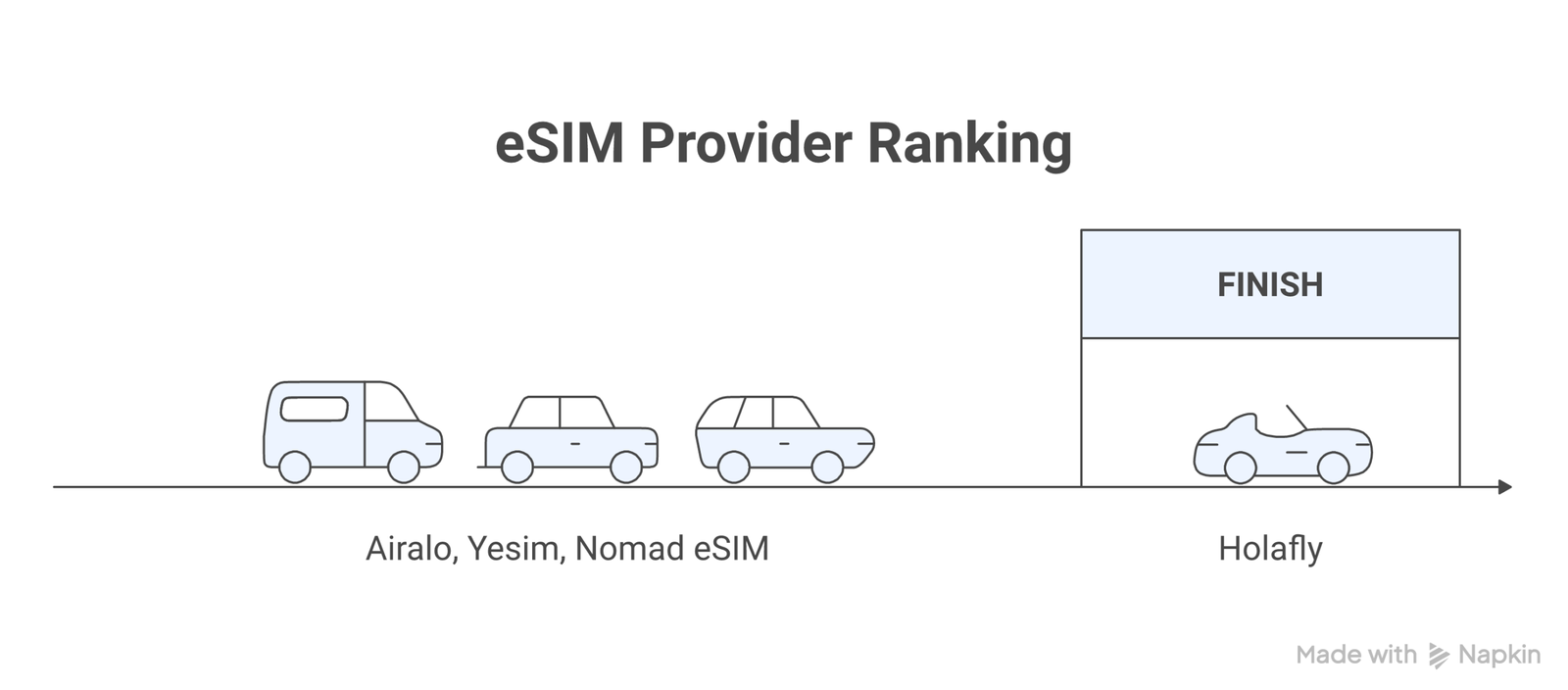
Holafly: Best Overall for Unlimited Data
Holafly has built its reputation on unlimited data plans, and for good reason. They cover over 190 destinations with genuine unlimited data, meaning no speed throttling and no data caps. Prices start around $6/day for popular destinations like the US, most of Europe, and Japan.
What sets Holafly apart is simplicity. You pick a destination, choose your plan duration (5 to 90 days), install via QR code, and you’re connected. No worrying about how many GB you have left. Their app also includes a data usage dashboard so you can monitor connections even though there’s no cap to hit.
The main downside? Holafly doesn’t include tethering on most plans. If you need to share your phone’s connection with a laptop, you’ll need to look elsewhere or use their workaround via a call-forwarding setup. Also, their plans are data-only, with no local phone number for calls or texts.
✓ Holafly at a Glance
- ✓ True unlimited data (no throttling)
- ✓ 190+ destinations covered
- ✓ Plans from 5 to 90 days
- ✓ 24/7 customer support via chat
- ✗ No tethering on most plans
- ✗ Data-only (no calls/SMS)
Airalo: Best for Flexibility and Regional Plans
Airalo is one of the most popular eSIM marketplaces, with plans for over 200 countries and regions. While most Airalo plans have set data limits (1 GB, 3 GB, 10 GB, etc.), they’ve introduced “Discover+” regional plans with high enough data caps that they work as effectively unlimited for most trips.
Their Discover+ Global plan offers up to 20 GB across 130+ countries. For a two-week vacation, that’s more than enough for daily navigation, messaging, social media, and occasional video streaming. The International Telecommunication Union estimates average mobile data consumption at around 15 GB per month for travelers, so 20 GB should cover a typical trip comfortably.
Where Airalo really shines is price transparency. You see exactly what you’re paying for, there are no hidden fees, and their app makes managing multiple eSIMs easy if you visit several countries. They also support tethering on many plans, which is a win for laptop users.
Yesim: Strong Contender for Europe and Asia
Yesim is a Swiss-based eSIM provider that offers unlimited data plans for Europe, Turkey, the US, and several Asian countries. Their pricing is competitive: unlimited data in Europe runs about $4.50/day on longer plans.
Yesim includes a built-in VPN at no extra cost, which is handy for privacy-conscious travelers or anyone connecting to public WiFi at airports and hotels. The European Union Agency for Cybersecurity (ENISA) consistently warns about the risks of unsecured public networks, so having VPN included out of the box is a practical bonus.
The downside is coverage. Yesim’s unlimited plans cover fewer destinations than Holafly or Airalo. If you’re heading to Africa, South America, or the Pacific Islands, your options are more limited. But for Euro trips and popular Asian destinations like Thailand, Japan, and South Korea, they’re worth considering.
Nomad eSIM: Budget-Friendly with Generous Data
Nomad eSIM positions itself as a budget option, and the pricing backs that up. Their plans don’t always use the word “unlimited,” but they offer large data allotments (up to 20 GB) at some of the lowest prices in the market. A 10 GB plan for Europe costs around $16 for 30 days.
Nomad also offers regional plans covering multiple countries under a single eSIM. Their Asia plan, for example, works across 15+ countries. This is useful for multi-stop trips where you don’t want to juggle separate eSIMs for each country.
The trade-off is that Nomad’s network speeds can be inconsistent in some regions. While you’ll generally get solid LTE speeds in major cities, rural areas might see slower connections. Customer support is email-only, which can be frustrating if something goes wrong mid-trip.
Ubigi: Best for Multi-Device Users
Ubigi is backed by Transatel, a subsidiary of Japanese telecom giant NTT. That corporate backing translates to reliable network agreements across 190+ countries. Ubigi offers data-heavy plans up to 50 GB, which for most travelers functions as unlimited.
What makes Ubigi stand out is multi-device support. Their eSIM works on phones, tablets, laptops (including Windows devices with built-in eSIM), and even some smartwatches. If you travel with multiple connected devices, Ubigi lets you use a single plan across all of them through tethering, with no restrictions.
Pricing sits in the mid-range. A 10 GB global plan costs around $26 for 30 days. Not the cheapest, but the reliability and multi-device flexibility justify the premium for many travelers. They also partner with laptop manufacturers like Lenovo and Microsoft Surface, so some devices come with Ubigi pre-installed.
📝 Important Note
eSIM compatibility depends on your device. Most iPhones from the XS onward and Android flagships from 2020+ support eSIM. Check the Apple support page or your phone manufacturer’s specs before purchasing any eSIM plan. Carrier-locked phones may not work with third-party eSIMs.
How to Pick the Right Unlimited Data eSIM
Choosing the right provider depends on a few factors specific to your trip:
Destination coverage: Not every provider covers every country with unlimited data. Holafly has the widest unlimited coverage, but if you’re heading somewhere specific, check coverage maps first. The OpenSignal network coverage database is useful for checking actual signal quality in your destination.
Trip length: For short trips (under a week), per-day pricing matters more. For longer stays, monthly plans from Airalo or Ubigi often work out cheaper than daily-rate providers like Holafly.
Tethering needs: If you need to share your data connection with a laptop or other devices, rule out providers that block tethering. Airalo and Ubigi both support it on most plans.
Data usage: Be honest about how much data you actually use. If you mainly check email, use maps, and browse social media, a 10 GB plan will probably last your whole trip. True unlimited plans are worth the premium if you stream video, attend video calls for work, or upload large files regularly.
Setting Up Your Unlimited Data eSIM
The setup process is basically the same across providers. Here’s what to expect:
1. Purchase your plan through the provider’s website or app. You’ll receive a QR code via email or in-app notification.
2. Scan the QR code on your phone. On iPhone, go to Settings > Cellular > Add eSIM > Use QR Code. On Android, the path varies by manufacturer, but it’s usually under Settings > Network > SIM cards > Add eSIM. Google’s Android support page has device-specific instructions.
3. Label your eSIM (like “Travel Data” or “Europe Trip”) so you can easily switch between your regular SIM and the travel eSIM.
4. Activate when ready. Some eSIMs activate immediately upon installation. Others let you delay activation until you arrive at your destination. Installing the day before departure and activating on arrival is a common approach.
The whole process takes under five minutes. No store visits, no SIM tray tools, no fumbling with tiny chips at the airport.
Pricing Breakdown: What You’ll Actually Pay
To give you a real comparison, here’s what each provider charges for a 7-day unlimited (or high-data) plan in Europe as of March 2026:
Holafly: ~$27 for 7 days unlimited data (no throttling). Works across 30+ European countries.
Airalo (Discover+ Europe): ~$18 for 5 GB / 30 days or ~$32 for 10 GB / 30 days. Not technically unlimited, but the longer validity gives flexibility.
Yesim: ~$31.50 for 7 days unlimited in Europe. Includes VPN.
Nomad: ~$16 for 10 GB / 30 days in Europe. Best per-GB value.
Ubigi: ~$16 for 3 GB / 30 days global, ~$36 for 10 GB. Multi-device friendly.
For comparison, traditional international roaming through a major US carrier like T-Mobile or AT&T can cost $10-15/day. A week-long trip to Europe would run $70-105 in roaming fees alone, making even the priciest eSIM option a bargain by comparison.
✓ Money-Saving Quick Comparison
- ✓ Best for true unlimited: Holafly (~$27/week)
- ✓ Best budget option: Nomad ($16/10GB/month)
- ✓ Best for tethering: Ubigi or Airalo
- ✓ Best with VPN included: Yesim
- ✓ Best for multi-country: Airalo Discover+
Common Pitfalls to Avoid
Not checking device compatibility. Your phone needs to be eSIM-capable AND unlocked. Phones purchased on contract from carriers may be locked. The CTIA (Cellular Telecommunications Industry Association) has guidelines on carrier unlocking policies.
Installing too late. Don’t wait until you land at your destination to install your eSIM. Airport WiFi can be unreliable, and you need an internet connection to download the eSIM profile. Install at home or your hotel before departure.
Ignoring the fair-use policy. Some “unlimited” plans have fair-use thresholds. Read the terms of service before purchasing. A plan that throttles after 5 GB is very different from one that throttles after 50 GB.
Forgetting to turn off your primary SIM’s data. If you keep your home SIM active for calls/texts, make sure to disable data roaming on it. Otherwise your phone might route traffic through the expensive home SIM instead of the eSIM.
Real-World Performance: What to Expect
Speed tests from multiple eSIM review sites and user reports show that most unlimited eSIM plans deliver 15-40 Mbps download speeds on 4G LTE networks. In cities with 5G coverage, speeds can reach 100+ Mbps with compatible devices and plans.
Latency typically ranges from 30-80ms, which is fine for video calls and even light gaming. The Ookla Speedtest Global Index tracks mobile speeds by country, so you can check what baseline speeds to expect at your destination.
One thing to keep in mind: eSIM providers rent capacity from local carriers. In tourist-heavy areas during peak season, congestion can slow things down regardless of your plan. Holafly and Airalo both partner with tier-1 carriers in most countries, which helps maintain consistent speeds even during busy periods.
If you’re a digital nomad relying on mobile data for work, we’d recommend testing your eSIM connection within the first hour of arrival. Switch between available networks if speeds are below expectations, as most eSIMs connect to whichever local partner network has the strongest signal.
💡 Pro Tip
Download offline maps in Google Maps or Apple Maps before your trip. Even with unlimited data, offline maps load faster and save battery. Think of your eSIM data as a backup, not your only navigation tool.
eSIM Unlimited Data vs. Pocket WiFi vs. Roaming
Travelers often debate between eSIMs, pocket WiFi devices, and carrier roaming packages. Here’s how they compare on the metrics that matter:
Cost: eSIMs win here. Unlimited eSIM plans cost $4-8/day. Pocket WiFi rentals run $8-15/day plus pickup/return hassle. Carrier roaming is $10-15/day for limited data. If you’ve been exploring whether a pocket WiFi or eSIM makes more sense, cost usually tips the scales toward eSIM.
Convenience: eSIMs are entirely digital. No extra device to charge, carry, or return. Pocket WiFi means another gadget in your bag. Roaming just works but costs a fortune.
Sharing: Pocket WiFi wins if you need to connect 5+ devices without worrying about tethering restrictions. For couples or small groups, an eSIM with tethering usually handles things fine.
Reliability: All three depend on the local cellular infrastructure. The underlying network is the same; you’re just paying different prices to access it.
⚠️ Disclaimer
Pricing and plan details mentioned in this article reflect publicly available information as of March 2026. eSIM providers frequently update their plans, pricing, and coverage areas. Always verify current details on the provider’s official website before purchasing. We may earn affiliate commissions from some links at no additional cost to you.
Frequently Asked Questions
Is unlimited data eSIM really unlimited?
It depends on the provider. Holafly offers true unlimited data with no throttling on most plans. Other providers like Airalo offer large data packages (10-20 GB) that function as effectively unlimited for typical travel use. Always read the fair-use policy before buying.
Can I use an unlimited eSIM for hotspot tethering?
Not always. Holafly restricts tethering on most plans, while Airalo and Ubigi allow it. If tethering is important to you, check the provider’s terms before purchasing. Ubigi is especially good for multi-device setups.
Which unlimited data eSIM provider is cheapest?
For true unlimited data, Holafly and Yesim offer the best value at roughly $4-6/day. For large-but-capped plans, Nomad offers the lowest per-GB pricing. The cheapest option depends on how much data you actually need and where you’re going.
Do unlimited eSIM plans include phone calls?
Most travel eSIM plans are data-only. You won’t get a local phone number for traditional calls. However, with unlimited data, you can use VoIP apps like WhatsApp, FaceTime, or Skype for calls over your data connection without any issues.
How fast is unlimited eSIM data?
Most unlimited eSIM plans deliver 15-40 Mbps on 4G LTE networks, with 5G capable plans reaching 100+ Mbps in supported areas. This is more than enough for streaming, video calls, and general browsing.
Can I keep my regular phone number while using an unlimited eSIM?
Yes. Most modern phones support dual SIM (physical + eSIM). Keep your regular SIM active for calls and texts while routing all data through the travel eSIM. Just disable data roaming on your primary SIM to avoid unexpected charges.